Nuns as Bears and lots of scratching! In conversation with Environmental Journalist Tracy Keeling about Sparks of Inspiration found through the process of Transformation and Imaginative Improvisation
A recent conversation with environmental journalist and playwright Tracy Keeling led us to discussing a process I often work in with actors for character transformation. Tracy and I first met while working in day jobs at Shakespeare’s Globe two decades ago. As our strands of work- mine in physical language and hers in verbal language have developed, we have stayed connected. We have common passions.
Tracy specialises in reporting on biodiversity, the wildlife trade, and animal agriculture. She says “I approach reporting in a similar way to how German dramatist Heiner Müller tackled theatre making (I too wrote plays in the not so distant past). He explained it thus: "I think my strongest impulse is to reduce things down to their skeleton, to tear off their skin and their flesh. Then I’m finished with them.”Tracy uses storytelling to provide sparks for action on the most pressing issues facing our planet and its life forms.
Below are some questions and answers about the process of Transformation and Imaginative Improvisation and how it works, from our recent conversation.
Tell me how you came to work in this process of Transformation and Imaginative Improvisation (where, when with whom?)
I was introduced to this approach to stagecraft, to Imaginative Improvisation and finally to Transformation by Catherine Clouzot in my acting training at Arts Ed, London in the late 90’s. Some years after I’d left, Catherine asked me to become her apprentice to take on this body of work. In 2005 I began teaching this to actors in their training and 20 years later I am still making exciting discoveries for performance and for storytelling.
Tell me about an animal you focused on.
Brown bear
Where were you able to see/observe your animal
At Wildwood in Herne Bay – Kent particularly through lockdowns in covid in the summer of 2020. The bears in focus had been rescued and were being rehabilitated. I’ve lots on my news/blog posts with footage taken from this time
What was the piece of theatre or role you developed for which your animal was key.
The early draft of a piece called Bears in Libraries…and…as with most of my stuff, this had been brewing for some time. Bear first grabbed my attention and wouldn’t let me go after reading Shaun Tan’s short story about Bears taking humans to court from his book, Tales From The Inner City. I began to work with actors from my theatre Company, (first on line due to covid,) and then in a theatre space when it became impossible for us to be separated in this way or to continue working in the often bedroom sized spaces we were in. With support from the Gulbenkian Theatre Canterbury, and Omnibus Theatre, Clapham, we started exploring scenes…working in bear in many different scenarios and environments. There was an abundance of material. Later that year I had the chance, thanks to Andrew Visnevski, to develop one idea that had been emerging from this exploration. I’d been twice before to Kalamata, Greece, to teach on a three week intensive summer theatre programme founded by Visnevski, now in its 8th year. During one visit I’d been taken to see an exhibition the Cultural Centre of Kalamata and popped up to the library at the top of this building. There I saw immediately the perfect venue to develop Bears in Libraries for.
What are some initial activities that were important for you when you came away from your looking and stepped into the rehearsal room to work?
The way the paws and the nails act to hold and get food. Their strength and also the specificity with which they can get into small crevices and extract edible substances.
The scratching into fur that can go on for so long- wonderful for me to allow myself to drop further into the weight and tempo I need to keep me in bear.
Is there an activity/ situation/moment you can talk about that enabled a specific and perhaps fundamental/powerful discovery for you in your human’s physical choices
There is some footage I took of the bears at Wildwood that I’ve spoken to actors before about who have worked in bear. It is of a bear dragging grasses
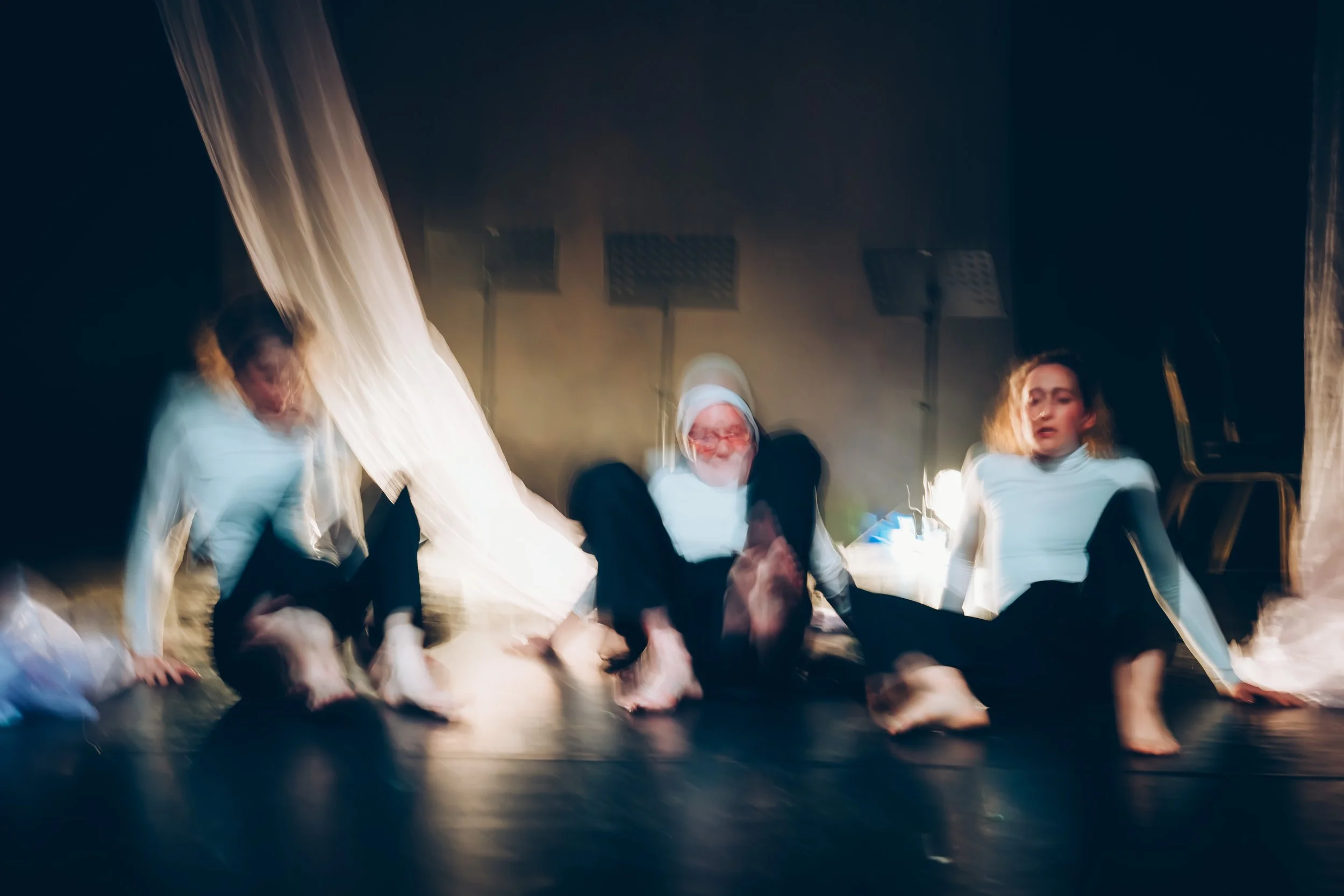
Independently of this Bear project I worked in Bear for a scene in a play conceived and created by Bound by Theatre– Kristin Winters about Hildegard of Bingen. Alot of physical exploration had already been done into pain (she had chronic pain all her life). We had also explored the sensuality of a woman in her private world washing herself. What I knew we needed, in my role as movement director on the piece, was to make visible the strength of her and I felt we could explore this through her connectedness to the earth. She was a woman who understood plants and made medicines. And wrote recipes. There was a scene late on in the play which required her brute strength to dig up grave stones to hide the whereabouts of a body. And so, bear seemed to me the animal we should all work in. We paid particular attention to specific footage, including moments of bears fighting, female bears defending their cubs and footage of the bear dragging grasses (including the snippet above) to make a bed. This was material that gave us good physical preparedness for the big moment of Hildegard dislodging, dragging and pushing gravestones in the night. This became the final scene of the play.
Is there an image/moment you can talk about that enabled a specific and perhaps fundamental/powerful discovery for you in your human’s world/ environment /situation
I suppose it would be some of the descriptions of bears used in circuses- even in children’s stories where bears are put into human clothing but also more graphic descriptions and footage of bears bring chained in concrete areas or having their teeth and nails filed. It was the chaining of bears in caged areas that I remembered when I first visited the Kalamata Library and saw its caged area. A scene for the piece emerged from the double image of valuable books being chained to areas in a library for their safe keeping and the ‘chattel’ of bears being chained in concrete cages. Dichotomies of images such as this one are for me the products of this sort of long research of giving one’s focus to a specific animal.
Is there something key for you in the animal that brings you straight back into remembering them – that gives you a visceral immediate contact point for going back in to your animal
Being able to have been physically close enough to the bears to have heard them breathing whilst going about an activity like scratching helps me return with an immediacy and profundity to bear.
Tracy and Gabrielle in conversation summer 2026
Photos by Desmond Liu from WIP performance of Not St Hildegard, conceived and created by Kristin Winters for The Women’s Voices festival at The Playground Theatre- London, March 2025.